 Add to Chrome
 Add to Firefox
 Add to Edge
Retell, Reward, Repeat: Reinforcement Learning for Narrative Theory-Informed Story Generation
Jan 23, 2026
Despite the subjective nature of storytelling, past works on automatic story generation (ASG) have relied on limited ground truths for training and evaluation. In this work, we explore reinforcement learning (d-RLAIF) as a post-training alternative to supervised fine-tuning (SFT). We first apply Todorov's Theory of Narrative Equilibrium to establish principles that define desirable ASG qualities. We prompt 7B and 14B LLM-as-judge models with our principles to test alignment with human annotators and provide reward signals during d-RLAIF. We use Gemini-3-Flash to evaluate the output of our post-trained models and compare them to human-written stories from the TimeTravel dataset. We show that d-RLAIF offers a viable alternative to supervised fine-tuning (SFT)--producing stories that are more diverse and aligned with human narrative conventions. Our paper demonstrates the promise of reinforcement learning for linguistically grounded post-training for subjective tasks such as ASG.

In Vino Veritas and Vulnerabilities: Examining LLM Safety via Drunk Language Inducement
Jan 19, 2026Humans are susceptible to undesirable behaviours and privacy leaks under the influence of alcohol. This paper investigates drunk language, i.e., text written under the influence of alcohol, as a driver for safety failures in large language models (LLMs). We investigate three mechanisms for inducing drunk language in LLMs: persona-based prompting, causal fine-tuning, and reinforcement-based post-training. When evaluated on 5 LLMs, we observe a higher susceptibility to jailbreaking on JailbreakBench (even in the presence of defences) and privacy leaks on ConfAIde, where both benchmarks are in English, as compared to the base LLMs as well as previously reported approaches. Via a robust combination of manual evaluation and LLM-based evaluators and analysis of error categories, our findings highlight a correspondence between human-intoxicated behaviour, and anthropomorphism in LLMs induced with drunk language. The simplicity and efficiency of our drunk language inducement approaches position them as potential counters for LLM safety tuning, highlighting significant risks to LLM safety.
Stablecoin Design with Adversarial-Robust Multi-Agent Systems via Trust-Weighted Signal Aggregation
Jan 18, 2026Algorithmic stablecoins promise decentralized monetary stability by maintaining a target peg through programmatic reserve management. Yet, their reserve controllers remain vulnerable to regime-blind optimization, calibrating risk parameters on fair-weather data while ignoring tail events that precipitate cascading failures. The March 2020 Black Thursday collapse, wherein MakerDAO's collateral auctions yielded $8.3M in losses and a 15% peg deviation, exposed a critical gap: existing models like SAS systematically omit extreme volatility regimes from covariance estimates, producing allocations optimal in expectation but catastrophic under adversarial stress. We present MVF-Composer, a trust-weighted Mean-Variance Frontier reserve controller incorporating a novel Stress Harness for risk-state estimation. Our key insight is deploying multi-agent simulations as adversarial stress-testers: heterogeneous agents (traders, liquidity providers, attackers) execute protocol actions under crisis scenarios, exposing reserve vulnerabilities before they manifest on-chain. We formalize a trust-scoring mechanism T: A -> [0,1] that down-weights signals from agents exhibiting manipulative behavior, ensuring the risk-state estimator remains robust to signal injection and Sybil attacks. Across 1,200 randomized scenarios with injected Black-Swan shocks (10% collateral drawdown, 50% sentiment collapse, coordinated redemption attacks), MVF-Composer reduces peak peg deviation by 57% and mean recovery time by 3.1x relative to SAS baselines. Ablation studies confirm the trust layer accounts for 23% of stability gains under adversarial conditions, achieving 72% adversarial agent detection. Our system runs on commodity hardware, requires no on-chain oracles beyond standard price feeds, and provides a reproducible framework for stress-testing DeFi reserve policies.
LangLingual: A Personalised, Exercise-oriented English Language Learning Tool Leveraging Large Language Models
Oct 27, 2025Language educators strive to create a rich experience for learners, while they may be restricted in the extend of feedback and practice they can provide. We present the design and development of LangLingual, a conversational agent built using the LangChain framework and powered by Large Language Models. The system is specifically designed to provide real-time, grammar-focused feedback, generate context-aware language exercises and track learner proficiency over time. The paper discusses the architecture, implementation and evaluation of LangLingual in detail. The results indicate strong usability, positive learning outcomes and encouraging learner engagement.
What am I missing here?: Evaluating Large Language Models for Masked Sentence Prediction
Aug 11, 2025Transformer-based models primarily rely on Next Token Prediction (NTP), which predicts the next token in a sequence based on the preceding context. However, NTP's focus on single-token prediction often limits a model's ability to plan ahead or maintain long-range coherence, raising questions about how well LLMs can predict longer contexts, such as full sentences within structured documents. While NTP encourages local fluency, it provides no explicit incentive to ensure global coherence across sentence boundaries-an essential skill for reconstructive or discursive tasks. To investigate this, we evaluate three commercial LLMs (GPT-4o, Claude 3.5 Sonnet, and Gemini 2.0 Flash) on Masked Sentence Prediction (MSP) - the task of infilling a randomly removed sentence - from three domains: ROCStories (narrative), Recipe1M (procedural), and Wikipedia (expository). We assess both fidelity (similarity to the original sentence) and cohesiveness (fit within the surrounding context). Our key finding reveals that commercial LLMs, despite their superlative performance in other tasks, are poor at predicting masked sentences in low-structured domains, highlighting a gap in current model capabilities.
LLMs for Law: Evaluating Legal-Specific LLMs on Contract Understanding
Aug 11, 2025Despite advances in legal NLP, no comprehensive evaluation covering multiple legal-specific LLMs currently exists for contract classification tasks in contract understanding. To address this gap, we present an evaluation of 10 legal-specific LLMs on three English language contract understanding tasks and compare them with 7 general-purpose LLMs. The results show that legal-specific LLMs consistently outperform general-purpose models, especially on tasks requiring nuanced legal understanding. Legal-BERT and Contracts-BERT establish new SOTAs on two of the three tasks, despite having 69% fewer parameters than the best-performing general-purpose LLM. We also identify CaseLaw-BERT and LexLM as strong additional baselines for contract understanding. Our results provide a holistic evaluation of legal-specific LLMs and will facilitate the development of more accurate contract understanding systems.
Nek Minit: Harnessing Pragmatic Metacognitive Prompting for Explainable Sarcasm Detection of Australian and Indian English
May 21, 2025Sarcasm is a challenge to sentiment analysis because of the incongruity between stated and implied sentiment. The challenge is exacerbated when the implication may be relevant to a specific country or geographical region. Pragmatic metacognitive prompting (PMP) is a cognition-inspired technique that has been used for pragmatic reasoning. In this paper, we harness PMP for explainable sarcasm detection for Australian and Indian English, alongside a benchmark dataset for standard English. We manually add sarcasm explanations to an existing sarcasm-labeled dataset for Australian and Indian English called BESSTIE, and compare the performance for explainable sarcasm detection for them with FLUTE, a standard English dataset containing sarcasm explanations. Our approach utilising PMP when evaluated on two open-weight LLMs (GEMMA and LLAMA) achieves statistically significant performance improvement across all tasks and datasets when compared with four alternative prompting strategies. We also find that alternative techniques such as agentic prompting mitigate context-related failures by enabling external knowledge retrieval. The focused contribution of our work is utilising PMP in generating sarcasm explanations for varieties of English.
A Survey on Multimodal Music Emotion Recognition
Apr 26, 2025Multimodal music emotion recognition (MMER) is an emerging discipline in music information retrieval that has experienced a surge in interest in recent years. This survey provides a comprehensive overview of the current state-of-the-art in MMER. Discussing the different approaches and techniques used in this field, the paper introduces a four-stage MMER framework, including multimodal data selection, feature extraction, feature processing, and final emotion prediction. The survey further reveals significant advancements in deep learning methods and the increasing importance of feature fusion techniques. Despite these advancements, challenges such as the need for large annotated datasets, datasets with more modalities, and real-time processing capabilities remain. This paper also contributes to the field by identifying critical gaps in current research and suggesting potential directions for future research. The gaps underscore the importance of developing robust, scalable, a interpretable models for MMER, with implications for applications in music recommendation systems, therapeutic tools, and entertainment.
CAMU: Context Augmentation for Meme Understanding
Apr 24, 2025
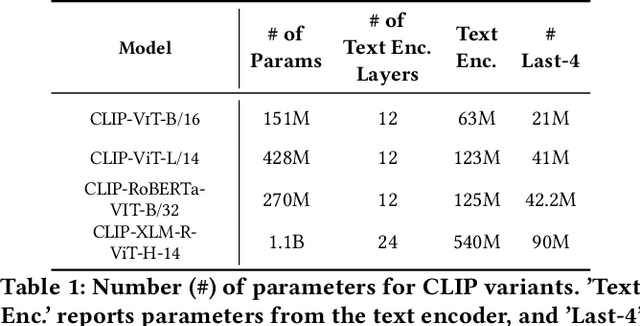
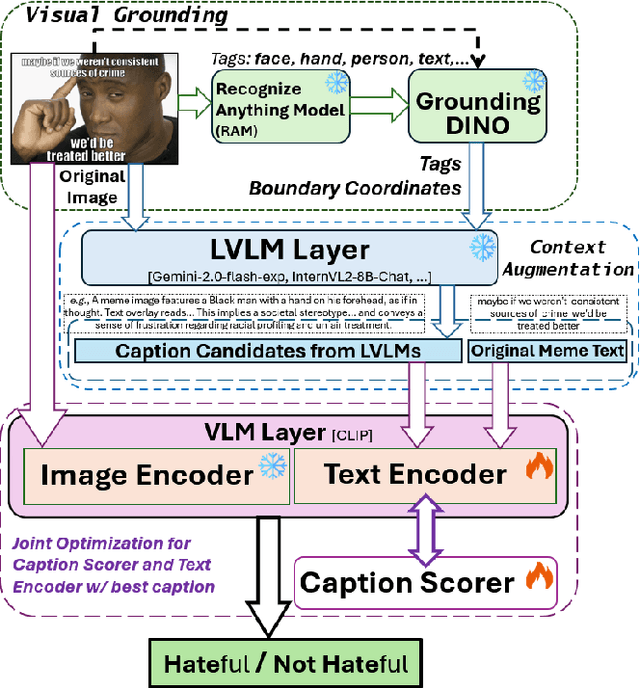
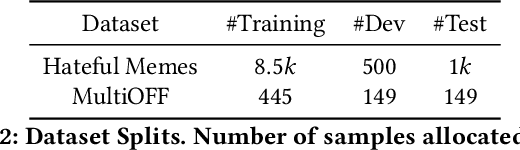
Social media memes are a challenging domain for hate detection because they intertwine visual and textual cues into culturally nuanced messages. We introduce a novel framework, CAMU, which leverages large vision-language models to generate more descriptive captions, a caption-scoring neural network to emphasise hate-relevant content, and parameter-efficient fine-tuning of CLIP's text encoder for an improved multimodal understanding of memes. Experiments on publicly available hateful meme datasets show that simple projection layer fine-tuning yields modest gains, whereas selectively tuning deeper text encoder layers significantly boosts performance on all evaluation metrics. Moreover, our approach attains high accuracy (0.807) and F1-score (0.806) on the Hateful Memes dataset, at par with the existing SoTA framework while being much more efficient, offering practical advantages in real-world scenarios that rely on fixed decision thresholds. CAMU also achieves the best F1-score of 0.673 on the MultiOFF dataset for offensive meme identification, demonstrating its generalisability. Additional analyses on benign confounders reveal that robust visual grounding and nuanced text representations are crucial for reliable hate and offence detection. We will publicly release CAMU along with the resultant models for further research. Disclaimer: This paper includes references to potentially disturbing, hateful, or offensive content due to the nature of the task.
Harnessing Test-time Adaptation for NLU tasks Involving Dialects of English
Mar 17, 2025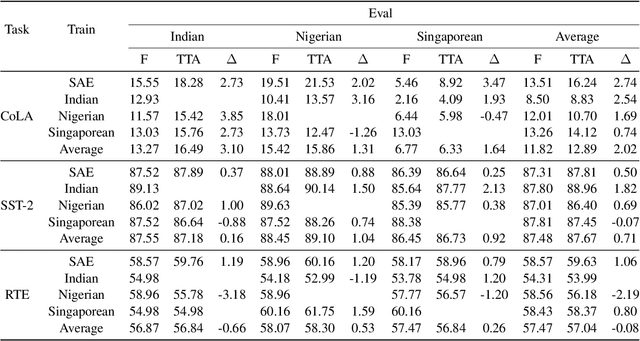
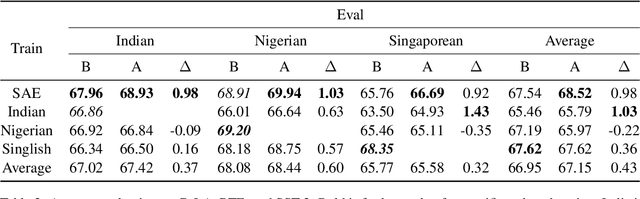

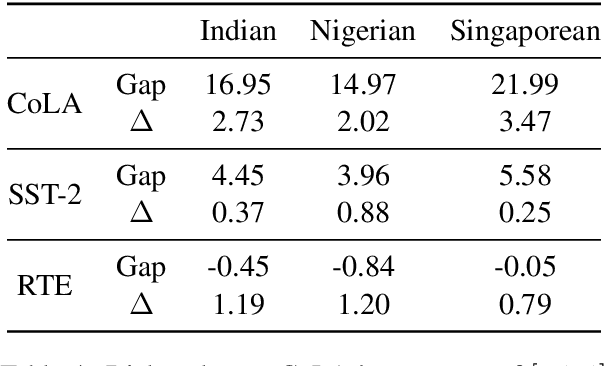
Test-time adaptation (TTA) is an excellent method which helps generalize models across domains, tasks, and distributions without the use of labeled datasets. Thus, TTA is very useful in natural language processing (NLP) in the dialectal setting, since oftentimes, models are trained on Standard American English (SAE), evaluated on Indian English or Nigerian English, of which distribution differs significantly from the former. This is especially useful since dialectal datasets are scarce. In this paper, we explore one of the most famous TTA techniques, SHOT, in dialectal NLP. We finetune and evaluate SHOT on different combinations of dialectal GLUE. Our findings show that SHOT is a viable technique when labeled datasets are unavailable. We also theoretically propose the concept of dialectal gap and show that it has a positive correlation with the effectiveness of SHOT. We also find that in many cases, finetuning on SAE yields higher performance than finetuning on dialectal data. Our code is available at https://github.com/dukenguyenxyz/dialect-adaptation